A 12V car refrigerator is more than a portable cooler with a power cable. Unlike passive coolers that only slow down temperature change, a compressor-based car refrigerator actively removes heat from the storage compartment to create a controlled cooling environment.
For outdoor travel, camping, road trips and mobile applications, cooling performance depends on several factors working together: compressor technology, insulation, compartment design, ambient temperature and vehicle power management.
Understanding how a 12V car refrigerator works helps explain why some portable fridges can freeze food, maintain stable temperatures and operate reliably during long journeys.
Different portable cooling products use different technologies.
A passive cooler mainly relies on ice packs or stored cold energy. It can maintain lower temperatures for a period of time, but it cannot actively remove heat entering the container.
A thermoelectric cooler uses the Peltier effect to move heat, but its cooling ability is usually limited by ambient conditions.
A compressor-based 12V car refrigerator works differently. It uses a refrigeration cycle to transfer heat from inside the cabinet to the outside environment.
The main difference can be summarized as:
| Cooling Type | Working Principle | Typical Application |
|---|---|---|
| Passive cooler | Stores cold energy | Short trips |
| Thermoelectric cooler | Transfers heat electronically | Light cooling needs |
| Compressor refrigerator | Actively removes heat | Long-distance travel and freezing |
A compressor refrigerator can maintain lower temperatures because it does not simply preserve existing cold—it continuously manages heat transfer.
A 12V car refrigerator uses a refrigeration system similar in principle to household refrigeration, but adapted for mobile environments.
The basic process includes:
Compressor
Compresses refrigerant and drives the cooling cycle.
Condenser
Releases heat from the refrigerant to the surrounding environment.
Expansion process
Reduces refrigerant pressure and prepares it for cooling.
Evaporator
Absorbs heat from inside the refrigerator compartment.
The key idea is that refrigeration does not create cold from nothing. Instead, it moves heat from inside the cabinet to outside the unit.
This is why external conditions matter. A refrigerator operating inside a hot vehicle has to remove more heat than one operating in a cool environment.
Many modern car fridge freezer products use dual-zone designs because travelers often need different storage conditions in one unit.
A dual-zone refrigerator creates two separate temperature environments, allowing users to configure compartments based on different needs.
Examples include:
One compartment for frozen food.
One compartment for fresh drinks or vegetables.
Two compartments with different cooling requirements.
The actual performance depends on several design factors:
Insulation between compartments.
Temperature sensor placement.
Compressor control logic.
Heat transfer management.
A dual-zone system is therefore not simply “two boxes in one.” It is a thermal management system designed to control different storage conditions simultaneously.
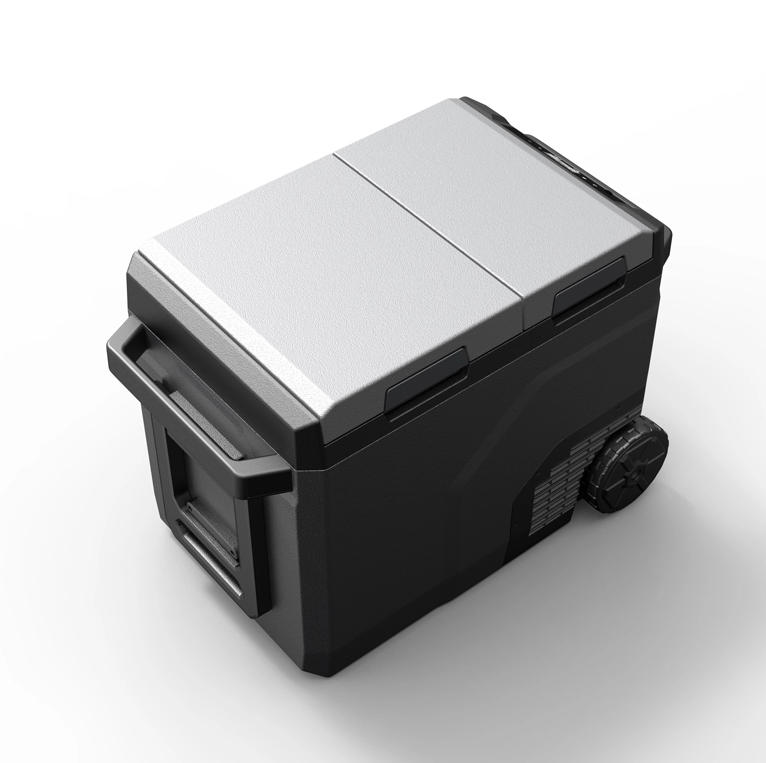
INVITOP PR series 12V car refrigerator models provide different capacity options, including 35L, 45L and 55L versions, with dual-zone independent temperature control for flexible storage during travel.
A portable refrigerator behaves differently when the vehicle is moving compared with when it is parked.
During driving:
The vehicle charging system may provide power.
The battery can support continuous operation.
Cooling conditions are usually more stable.
After parking:
The alternator stops producing power.
The refrigerator continues drawing electricity.
Interior vehicle temperature may rise significantly.
Cooling demand may increase.
This creates a balance between maintaining food temperature and protecting the vehicle battery.
A well-designed mini car refrigerator 12v system must therefore consider both cooling performance and power management.
Battery protection is an important feature for portable refrigerators because a vehicle battery has two different roles:
Supplying power to accessories.
Providing enough energy for engine starting.
A refrigerator with battery protection monitors supply voltage and adjusts operation when voltage drops below a certain level.
The purpose is not to increase battery capacity. Instead, it helps preserve available voltage for vehicle operation.
INVITOP car refrigerators include three-level car battery protection, allowing users to select protection settings according to different vehicle conditions.
This is especially useful during camping or outdoor applications where the refrigerator may operate for extended periods without the engine running.
A home refrigerator usually stays in one fixed location. A 12V car refrigerator faces much more demanding conditions.
Important factors include:
Vehicle vibration.
Uneven road surfaces.
Outdoor temperature changes.
Frequent opening and closing.
Limited ventilation space.
Insulation affects how quickly heat enters the cabinet. Better insulation reduces compressor workload and helps maintain temperature more efficiently.
Vibration resistance is also important because mobile refrigeration equipment must continue operating while exposed to movement.
INVITOP portable car refrigerators are designed with insulated bodies and anti-vibration features to support travel environments.
A portable refrigerator is limited by available power, especially during camping or off-grid use.
Compressor efficiency affects:
Cooling speed.
Energy consumption.
Battery operating time.
Temperature stability.
A more efficient system does not simply cool faster. It can maintain required temperatures while reducing unnecessary power consumption.
This is why evaluating a car fridge freezer requires more than looking at temperature range alone. Users should also consider insulation, compressor performance and power protection.
A 12V car refrigerator combines refrigeration technology, insulation design, power management and mechanical durability into one mobile system.
Compressor cooling determines how heat is transferred, dual-zone design improves storage flexibility, and battery protection helps balance cooling needs with vehicle power availability.
For road trips and outdoor applications, the best portable refrigerator is not only about reaching a low temperature—it is about maintaining reliable cooling performance under changing real-world conditions.
A 12V car refrigerator uses a compressor refrigeration cycle to remove heat from inside the cabinet and release it outside.
Yes. Compressor-based models can typically reach freezing temperatures depending on design and operating conditions.
A cooler mainly preserves existing temperature, while a compressor refrigerator actively removes heat.
It can consume vehicle power, but battery protection features help reduce the risk of excessive discharge.
It monitors voltage levels and helps protect the vehicle battery reserve needed for starting.
A dual-zone car fridge uses separated compartments and temperature controls to manage different storage conditions.