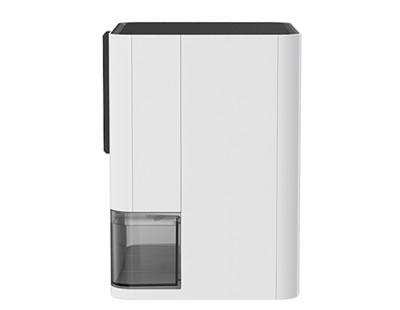
For most homes, the right dehumidifier depends more on room temperature, moisture load, and room size than on technology alone.
A compressor dehumidifier is generally the practical choice for warm, humid rooms where stronger moisture removal is required. A desiccant dehumidifier performs better in cooler spaces because it does not rely on a cold evaporator coil to condense water. A Peltier dehumidifier is better suited to small spaces where quiet operation and compact size matter more than high extraction capacity.
| Type | Best Suited To | Main Advantage | Main Limitation |
|---|---|---|---|
| Compressor | Warm, humid rooms | Higher moisture removal | Performance falls as temperatures become colder |
| Desiccant | Cool rooms | Stable low-temperature performance | Typically uses more heat and energy |
| Peltier | Bedrooms and small spaces | Compact and quiet | Lower extraction capacity |
The main difference is how each technology removes moisture from the air, which directly affects where it performs best.
A compressor type dehumidifier draws humid air across a cooled coil. Water condenses on the coil and drains into a tank. This method can remove substantial amounts of moisture when the surrounding air is relatively warm.
A desiccant unit passes air through a moisture-absorbing material. Because water removal does not depend on cooling the air below its dew point, performance remains more stable in cooler environments.
Peltier technology uses a thermoelectric module to create hot and cold surfaces. Moisture condenses on the cold side. The system is mechanically simple and compact, but its extraction capacity is normally much lower than that of a compressor system.
The result is not that one technology is universally better. Each solves a different household moisture problem.

For a small bedroom, study, dressing room, or similarly limited area with moderate humidity, a compact Peltier dehumidifier can be a practical choice.
Its strongest advantages are compact dimensions and low mechanical noise. Without a refrigeration compressor, it can operate with less vibration, which matters when the appliance is positioned close to a bed or desk.
The limitation is capacity. A small Peltier unit should not be expected to deal with severe condensation or a large, persistently damp room simply because its tank fills with water.
When comparing models, pay more attention to the stated extraction capacity and recommended coverage area than to tank size. A large tank allows less frequent emptying; it does not make the dehumidifier remove moisture faster.
Desiccant technology usually has the advantage when room temperatures remain low.
A compressor system needs a sufficiently cold evaporator surface to condense moisture. As ambient temperature drops, maintaining efficient condensation becomes more difficult and frost management may further reduce effective extraction.
A desiccant system does not depend on the same refrigeration cycle, so it can remain useful in cooler rooms.
For a normally heated bedroom or living area, however, this low-temperature advantage may not justify choosing desiccant technology. In warmer household conditions, compressor models generally provide stronger moisture removal for larger moisture loads.
When a room regularly experiences heavy condensation, damp walls, indoor laundry moisture, or persistently high relative humidity, extraction capacity becomes more important.
In warm conditions, a compressor dehumidifier is normally better suited to this workload than a small thermoelectric model. Instead of asking only whether a machine can collect water, consider how quickly it can bring the room toward the target humidity and maintain it there.
Peltier models make more sense when the moisture problem is localized and moderate.
Desiccant models become more attractive when high moisture is combined with low room temperature.
This distinction prevents a common purchasing mistake: choosing a very small dehumidifier for a moisture problem that requires substantially greater air-processing capacity.
They can be, particularly because desiccant systems normally require heat to regenerate the moisture-absorbing material.
However, wattage alone does not tell the whole story.
A lower-powered appliance that needs to operate almost continuously may not necessarily be more economical than a higher-capacity appliance that reaches the target humidity much faster.
For household buyers, a better comparison is:
room conditions + extraction performance + operating time
rather than simply choosing the model with the lowest watt rating.
This is also why manufacturers and buyers evaluating a commercial desiccant dehumidifier for sale should compare performance under realistic temperature and humidity conditions instead of relying only on headline liters-per-day figures.
Start with the room rather than the product.
Choose Peltier when the space is small, the moisture problem is moderate, and quiet operation is important.
Choose compressor when the room is warmer and requires faster or higher-volume moisture removal.
Choose desiccant when low room temperature is a major operating condition and consistent cold-weather extraction matters.
For a typical household application, there is little benefit in buying excessive capacity. But undersizing creates its own problem: the machine may run for long periods without bringing humidity under control.
A reliable dehumidifier factory should therefore provide more than a nominal extraction figure. Room coverage, test conditions, operating temperature, noise, drainage options, and humidity control range all help buyers judge whether a model is suitable for its intended use.
Compressor, desiccant, and Peltier dehumidifiers are designed around different operating conditions.
For small household spaces with moderate moisture, Peltier technology offers a compact and quiet solution. Compressor models are more appropriate when warm, humid rooms require stronger extraction, while desiccant models have a clear role in colder environments where refrigeration-based performance declines.
The most useful question is therefore not “Which technology is best?” but “Which technology matches the temperature, room size, and moisture load of the space?”
INVITOP develops multiple dehumidification technologies for different household requirements, allowing buyers and distributors to select products according to actual operating conditions rather than relying on a single dehumidifier platform.
Yes. It can be suitable for a small bedroom with moderate humidity, particularly when compact size and quiet operation are important.
Yes, but their extraction capacity is lower than most compressor models. They are better for small spaces than severe damp problems.
A desiccant dehumidifier is generally better suited to consistently cool rooms because its moisture removal does not rely on refrigeration condensation.
It can be, particularly if humidity is high. Capacity should still be matched to the room rather than choosing the largest model available.
For most homes, keeping relative humidity roughly within the 40–60% range provides a practical balance between excessive dampness and overly dry air.